These are two pages from a pitch for a comic my friend Stephen Pellnat and I are hoping to do, called “The Last Slice of Mushroom Pie.”


There have been two superhero changes announced this week, both to fairly big-name characters. That means nothing in the long run, because big-name characters always revert back to the original form after a while, but that’s also what’s sort of cool about these mainstream comic book characters – they can continuously be retold and rebuilt in different ways, and if you don’t like the new version, just check back again in a year or two.
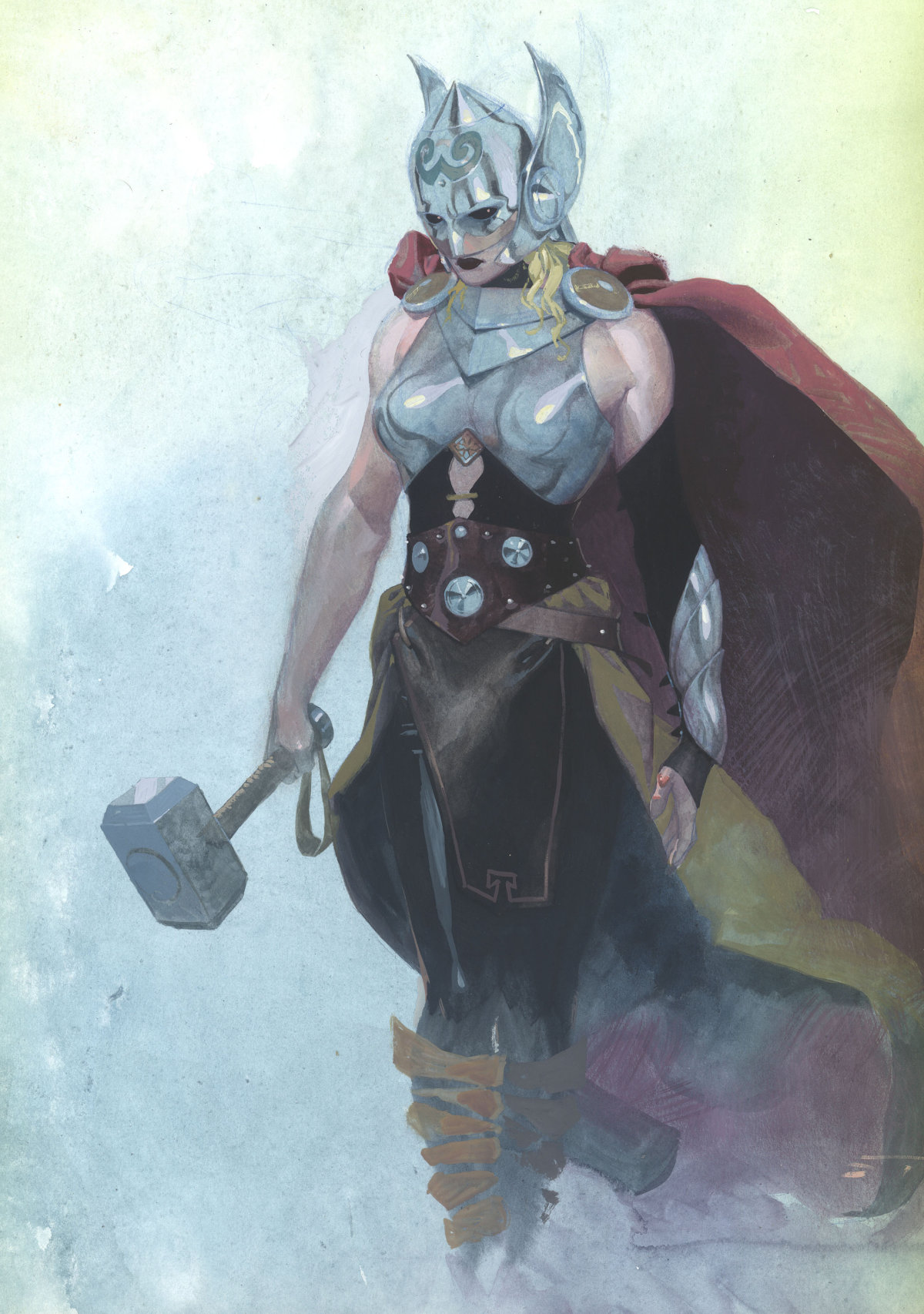
First of all, Marvel Comics announced that Thor will be a woman (thanks to Guthrie for pointing this out in comments). See, in the Thor comic book, anyone who is worthy (noble, brave and so forth) and picks up the big Thor hammer becomes a new incarnation of Thor (a fairly blatant imitation of Green Lantern’s ring). I don’t think this has come up in quite a while, but in the classic Walt Simonson run in the 1980s this feature was used to make Thor an orange-skinned alien named Beta Ray Bill for an extended plotline. He was also a frog for three issues.
Anyway, the new Thor:
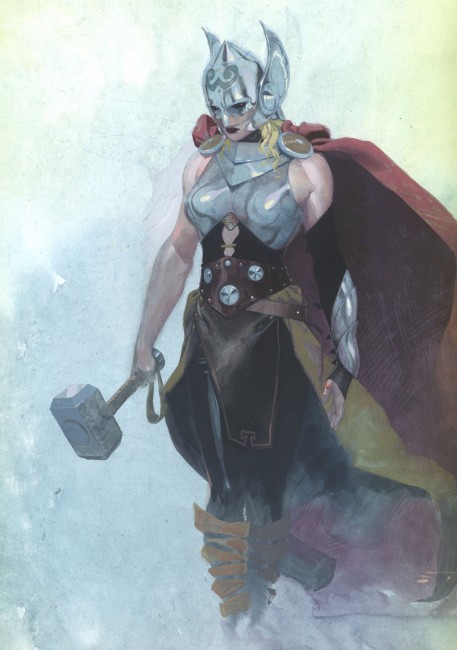
I’m feeling underwhelmed by this costume design. First of all, boob-plates suck as armor. And is that a belly window below the boob plate? No, no, no. Plus it’s sort of a dull design – if Marvel had gone for a female Thor a quarter-century ago, it might have looked like this. It says “female Thor,” but it has no personality beyond that. Points for giving her pants, I guess.
But what about the coolness factor of Thor being a woman? Well, it might be cool, if the comic is well-written – but this costume design doesn’t bode well, because it suggests that they didn’t give much thought to this beyond the gimmick. Also, this particular character change comes with an exparation date, because there is no way Marvel won’t have Thor revert to being a big buff guy by the time either Avengers 2 or Thor 3 come out.
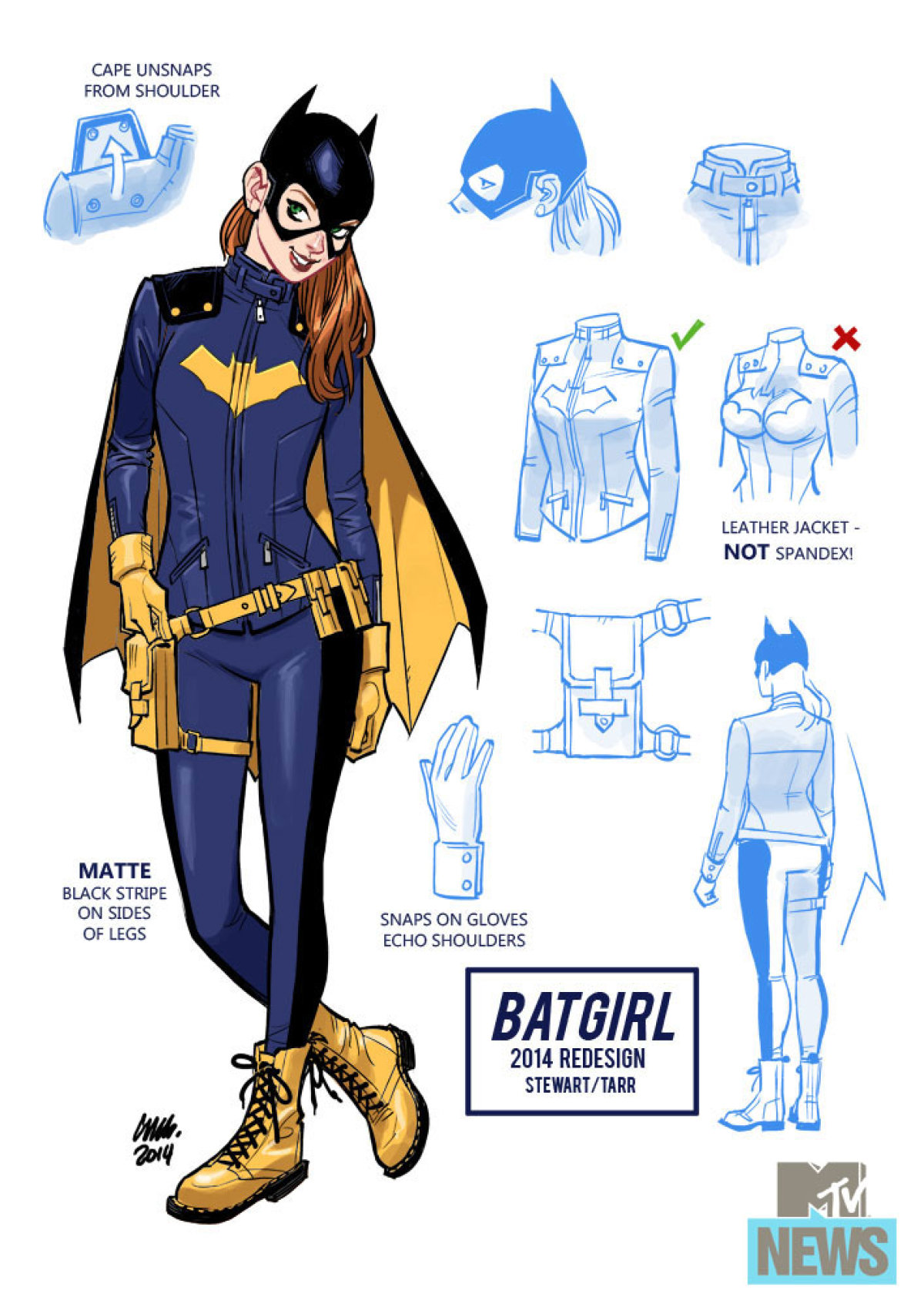
Meanwhile, over at DC, fan-favorite feminist writer Gail Simone’s run on Batgirl is coming to an end. Interestingly, rather than continuing the mood of Simone’s run – which has been classic Bat-book grimdark – the new creative team has decided that Barbara Gordon will lose all her possessions (and her current costume) in a fire, move to Gotham’s equivalent of hipster Brooklyn, attend grad school, and have a tone that they claim will be a mix of “Veronica Mars,” “Sherlock,” and – implausibly – “Girls.” Here’s the new costume design:
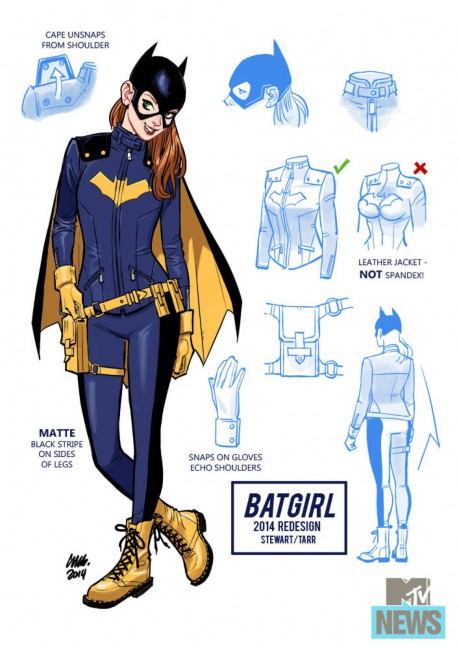
This is a MUCH better costume design – recognizably Batgirl, but full of personality and telling a story. (After the fire, the character puts together a new costume out of thrift store finds.) Dean Trippe at Project Rooftop (a superhero costume design blog) writes:
This look, a collaboration from Babs and Cameron, features such wonderful clarity and control. The overall vibe reminds me of the jacketed look of my first Batgirl redesign (don’t look at it, it was ages ago), which helped launch this entire enterprise here at P:R, but this has so much more detail and cleverness. It’s physical. It’s stylish. It’s practical at every level. The over-the-ears cowl, the snap-away cape, everything about this new Batgirl is wicked.
Also, all the seams in DC costumes since the “new 52” design have really annoyed me, because they look inauthentic – as if the designer doesn’t know what seams are or how they function. In contrast, the seams here not only look good, they look plausible.
Will the comic be any good? I hope so. It’s possible that the creators will end up doing a charmless book full of sexist “she’s so girly and silly” cliches. But the costume bodes well – it suggests that they have a strong concept and have thought it through. And I like that there are women on this creative team (as there were on the previous team, of course).
P.S. There’s an amazing amount of new Batgirl fanart already.
P.P.S. The “NOT spandex” note and illustration cracks me up. (“Spandex” is a superhero term of art meaning “body paint,” it appears.)

I’ve got a guest strip on Jake Richmond’s webcomic “Modest Medusa” today; Jake is my housemate, my studiomate, and the colorist of “Hereville.” Bizarrely, considering we share a home and a workplace, it feels like I don’t actually see Jake all that often.
Anyhow, click on the panel to read the whole guest strip. It was lotsa fun to draw.
* * *
Also, my friend Ben Hsu is having a kickstarter for the first book collection of Licensed Heroes, a webcomic Ben writes and Elaine Tipping draws. On the surface a swords-and-monsters adventure set in a generic D&D world, it quickly turns out to be a lighthearted not-very-disguised autobiographical strip about being young and with no money and no idea how to proceed. But, you know, with monsters.
And while I’m linking Kickstarters I’ve supported, fans of Jewish comics should definitely check out The Jewish Comix Anthology, which looks like it’ll be really excellent.
This is by no means a comprehensive list – I haven’t read everything out there! And there are plenty I’ve read that I’m probably forgetting at the moment. But librarians ask me often enough for graphic novel recommendations that it seemed worthwhile to compile a list.
These are all graphic novels that I’ve personally read and enjoyed. They all have genuinely top-notch cartooning, and I’m confident kids will enjoy them. I’ve tried to make a list that includes both “obvious” graphic novels, and lesser-known works that are nonetheless excellent and entertaining.
Some graphic novels for all ages.
- Bone, by Jeff Smith.
- Smile , by Raina Telgemeier.
- And also Drama, by Raina Telgemeier. Raina’s books are magic; she has a direct portal from her drawing board to the hearts of young girls everywhere. It’s uncanny.
- Beanworld, by Larry Marder.
- American Born Chinese by Gene Lee Yang
- Inuyasha, by Rumiko Takahashi.
- Castle Waiting, by Linda Medley. I love both Castle Waiting books; fantasy that emphasizes friendship and humor rather than danger and daring, and somehow is fascinating rather than cloying. Plus, no one draws castle architecture better than Linda Medley.
- Rapunzel’s Revenge, by Shannon Hale and Nathan Hale.
- Courtney Crumrin, for those kids who like stories that are gently macabre.
- Jellaby, by Kean Soo. Out of print, as is the sequel, but available secondhand and worth it; sweet and unique.
- Meanwhile, by Jason Shiga. A completely fresh take on the choose-your-own-adventure genre.
- Nathan Hale’s Hazardous Tales, by Nathan Hale.
- Amulet, by Kazu Kibuishi
- A Wrinkle in Time: The Graphic Novel, amazingly well adapted by Hope Larson from Madeleine L’Engle’s novel. I’m not generally favorably inclined towards adaptations, but this one is an exception.
- Yotsuba&! by Kiyohiko Azuma.
- Zita the Spacegirl, by Ben Hatke.
- Friends with Boys, by Faith Erin Hicks.
- Babymouse, by Jennifer Holm and Matthew Holm. (Okay, this one isn’t “all-ages,” it’s for little kids.)
- Amy Unbounded, by Rachel Hartman.This is a “hidden gem,” long out of print and available only used. A fantasy comic full of accurate details about the daily life of a bright ten-year-old girl in the middle ages.
- The Baby-Sitters Club, by Ann M Martin and Raina Telgemeier. I normally tend to recommend more “indy” titles, but the charm and excellent cartooning in these three books is irresistible.
Superhero Graphic Novels. Gotta have a few of ’em, I guess. Other than Superhero Girl and Supergirl, these are for older kids rather than all-ages.
- The Adventures of Superhero Girl, by Faith Erin Hicks. More of a parody of superheros than a standard superhero book, this one can be enjoyed by both superhero fans and superhero skeptics, and contains no grimness and next to no violence.
- Supergirl: Cosmic Adventures in the 8th Grade, by Landry Walker and Eric Jones. This graphic novel, about an 8th grade Supergirl trying to find her way through school and through superheroing, is just ridiculously fun. There’s a little superhero violence, but nothing gory or brutal, and the theme of a misfit struggling to fit in will be relatable for many middle schoolers.
- Zot!: The Complete Black and White Collection, by Scott McCloud. This is my favorite superhero comic. It is optimistic rather than grim, and although it has moments of intense adventure it’s not especially violent. A teen coming-of-age novel in superhero form, the hero’s girlfriend Jenny is at least as much the protagonist as Zot himself is. There’s an earlier color Zot! book, which I also like, but the black-and-white book is better and can be read on its own.
- Runaways, by Brian K. Vaughan, Adrian Alphona, Joss Whedon and Michael Ryan. Fun superhero action with a diverse cast of main characters. Like most superhero comics, Runaways can get rather grim and violent; there are betrayals and some characters die. I only recommend the first eight volumes, after that the quality plummets.
- Watchmen, by Alan Moore and Dave Gibbons. THE classic of the superhero genre, much better than the movie of the same name. WARNING: Extreme grimness and violence, and some sexual scenes depicted non-explicitly, including one panel depicting a rape.
- Batman, Year One, by Frank Miller and David Mazzucchelli. If you’re going to stock just one Batman graphic novel, this is the one. Christopher Nolan clearly kept this book by his bedside while he was making “Batman Begins,” but the version on paper is much better. Grim and violent, however.
Graphic Novels For Older Kids – books with death, tougher themes, etc..
- Incognegro, by Mat Johnson and Warren Pleece.
- Maus, by Art Spiegleman.
- Persepolis, by Marjane Satrapi.
- I Kill Giants, by Joe Kelly and J.M. Ken Nimura. (Might be okay for middle school kids, too. I need to reread it to see. But it has some tough themes about bullying and trauma, so I’m putting it here for now).
- Anya’s Ghost, by Vera Brosgol. WARNING: The main character – who is wonderfully written – smokes and swears. (Although I think she quits smoking by the end of the book).
- Aya, by Marguerite Abouet. As well as being a gorgeous comic book, this is the one of the best portraits of daily life in Africa (specifically, the Ivory Coast) you’ll ever read. Again, might be okay for middle schoolers, but I’d have to reread to be sure.
- The Tale of One Bad Rat by Bryan Talbot. Excellent graphic novel about a girl recovering from sexual abuse.
- Ivy, by Sarah Oleksyk. WARNING: This book contains R-rated nudity, sex, drug use, and swearing, so may not be for every library, despite its high quality. A realistic coming-of-age novel about a young girl and wannabe artist.
- Understanding Comics, by Scott McCloud. An entertaining comic book textbook about the medium of comic books, this won’t appeal to all kids, but the intellectual nerdy comic book fan types may dig it.
- Making Comics, by Scott McCloud. This is the book I recommend to high schoolers who are beginning to get serious about making their own comics and want to know what they should read.
Some All-Age Classics
- Pogo, by Walt Kelly
- Peanuts, by Charles Schulz
- Uncle Scrooge, by Carl Barks
- Calvin and Hobbes, by Bill Watterson
- The Adventures of Tintin: Red Rackham’s Treasure ) and…
- The Adventures of Tintin: The Secret of the Unicorn, both by Hergé. Normally I don’t recommend particular books within a series, but if you get only 2 Tintin books, get these two (which form a single two-part story). They’re both an example of Hergé’s cartooning at its best, and also an example of a Hergé book without any offensive racial stereotypes to worry about. (Although one character is an alcoholic.)
- Moomin, by Tove Jansson.
And hey, while you’re at it, please consider picking up a copy of Hereville. :-p

My short story “How To Make A Man Out of Tin Foil” is online! This angsty story about boyhood and masculinity at a Jewish summer camp is now available on Bitch Magazine’s website.
I did this story for the upcoming feminist comics anthology The Big Feminist BUT, an anthology of feminist comics by both women and men. The list of contributors is, frankly, AMAZING — Hope Larson! Jeffrey Brown! Sarah Oleksyk! Jen Wang! Shaenon Garrity! Tom Neely! — and I can’t wait to read my copy. If you’re interested, please kick in a few bucks to the Big Feminist BUT’s kickstarter campaign.
Yesterday (October 20) was 24 Hour Comics Day!
What’s a 24 Hour Comic, you ask? It’s an invention of Scott McCloud’s:
To create a complete 24 page comic book in 24 continuous hours.
That means everything: Story, finished art, lettering, color (if applicable), paste-up, everything. Once pen hits paper, the clock starts ticking. 24 hours later, the pen lifts off the paper, never to descend again. Even proofreading has to occur in the 24 hour period. (Computer-generated comics are fine of course, same principles apply).
Although one can do a 24-hour comic any day of the year, it’s more fun to do it in tandem, hence 24 Hour Comics Day. Yesterday, at the studio where I work, myself, Jake Richmond, Ben Lehman, and Alan Ward all did 24 hour comics.
So here’s mine. It’s silly and not enormously well written or drawn, but perhaps you’ll enjoy it anyway. And it not, at least it won’t take more than a few minutes to read.

Continue Reading…
My friend Ken Koral, who does the excellent horror webcomic Eventy-Seven, did this hilarious drawing of the troll from Hereville.

Is that awesome or what?
My friend, the brilliant cartoonist Jenn Lee, is self-publishing the first book of her sci-fi webcomic Dicebox. Last week she posted the flip-through:
Jenn let me contribute a blurb to Dicebox. Here’s what I wrote:
Molly and Griffen are blue-collar workers in space looking for work and avoiding past mistakes. Jenn Manley Lee’s unique brand of science fiction — part slice of life, part travelogue — is daring, refreshing, whip-smart, and gloriously entertaining.
And Scott McCloud’s blurb:
In Jenn Manley Lee’s elegant pages, the mysteries of the universe are matched by the mysteries of the human mind. Dicebox is science fiction done right.
The book also includes a short Dicebox story written and drawn by me, years ago. (I’m kind of embarrassed by my old artwork, to be honest, but Jenn says she likes it.)
Dicebox is available as a hardcover, a softcover, and a very affordable pdf — all three versions are for sale at Jenn’s store. A warning, though: The book does have a little sex and a little swearing, so probably for grown-ups only.
On September 12, 2011 · Comments Off on Rochelle Wayne, also known as Robin, on a gigantic toy dinosaur
Ongoing work-in-progress for a drawing that will be auctioned off as part of this year’s “Women of Wonder Day.” The woman in the drawing is Rochelle Wayne, who was Robin in an “Elseworlds” Batman comic set during the French Revolution. Rochelle Wayne was designed by the wonderful José Luis García-López; my attempt to draw García-López hair looks pretty silly, but it was fun to try!
The completed drawing will include 4 female Robins, 5 Batgirls, 2 Batwomen, 2 female Black Bats, Huntress, Spoiler, Oracle, and Ace the Bat-Hound.

|
|